

奥特曼发表了一篇关于智能时代的文章:我们可能在“几千天”中拥有非常AI





9月24日,OpenAI 山姆·奥特曼CEO(Sam Altman)很少在其个人社交平台X上发表一篇名为《智能时代》的长文("The Intelligence Age"),引起了超过百万次的观看。
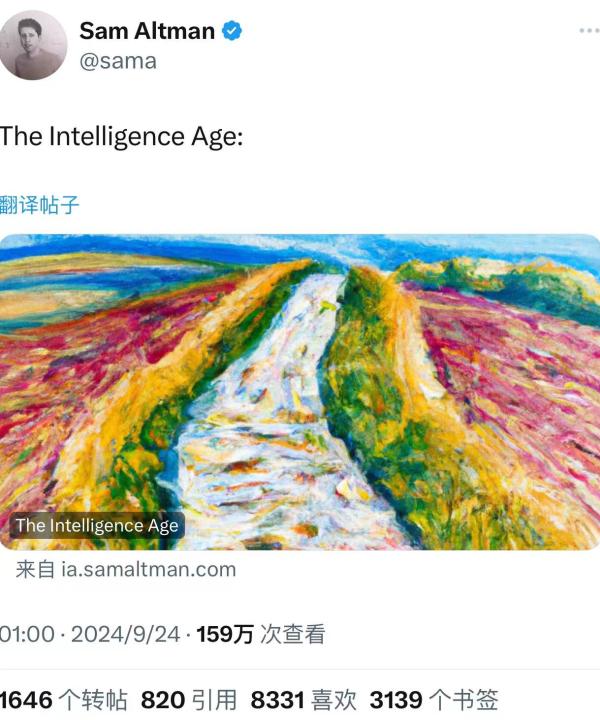
在这篇长文中,山姆·奥特曼讲述了他未来对人工智能驱动的技术进步将带来全球繁荣的愿景。他认为未来十年可能会出现超级人工智能。
奥特曼把我们现在所处的时代称为“智能时代”的黎明。深度学习算法的成功是这个新时代的催化剂。随着规模的扩大,人类可能会在几千天内实现超级智能化。
然而,他还提到,AI技术也会有缺陷。“它会对劳动力市场(好与坏)产生显著的变化。”我们现在应该努力,最大限度地发挥人工智能的好处,最大限度地减少其危害。”他预测,未来人工智能将在教育、医疗、软件开发等领域取得突破。
下面是奥特曼《智能时代》的全篇:
在接下来的几十年里,我们将能够做一些被祖父母视为魔法的事。
这种现象并不新鲜,但会加速。随着时间的推移,人类的能力将会显著提高。现在我们可以完成一些前辈认为不可能的事情。
我们的能力不是因为基因的变化,而是因为我们比任何人都更聪明、更强大,得益于社会基础设施的支持。从某种意义上说,社会本身就是一种高级智能。我们的祖父母和前几代人取得了辉煌的成就,他们为我们的人类进步建立了一个系统结构,每个人都从中受益。AI将为人们提供复杂问题的工具,帮助我们增加新的支柱,这是我们无法想象的。进步的故事将继续,我们的孩子将能够做我们现在不能做的事。
所有这些都不会很快发生,但是我们可以很快地与人工智能合作,完成比以前更多的任务。最后,每个人都可以有自己的人工智能团队,各个领域都有虚拟专家。他们共同努力,创造几乎可以想象的一切。儿童将拥有提供个性化指导的虚拟导师,可以涵盖任何科目、任何语言,并以所需的速度学习。对于更好的医疗健康,开发任何人都能想象的软件,我们可以想象类似的方案,等等。
有了这些新的能力,我们就可以实现共享繁荣,达到今天难以想象的高度。未来,每个人的生活都会比现在任何人的生活都好。虽然繁荣本身不一定能让人快乐——有很多富有却痛苦的人——但它会显著提高世界上每个人的生活质量。
从狭义的角度来看人类历史:经过几千年的科学发现和技术进步的积累,我们已经找到了如何将沙子融化并添加杂质,以惊人的精度将它们排列成一个非常小的计算机芯片,供它们通电,最终获得一个能够创造越来越强大人工智能的系统。
到目前为止,这可能是历史上最重要的事实。我们可能会在几千天内实现超级智能!这可能需要更长的时间,但我相信我们最终会实现这个目标。
所以,我们怎样才能实现下一个繁荣飞跃?
可用六个字来形容:深度学习是有效的。
总之,深度学习的成功,随着规模的扩大,可以预见它会变得更好,所以我们倾注了更多的资源。
就这么简单;人类发现了一个可以真正学习任何数据分布的算法(或者产生任何数据分布的基本“规则”)。令人震惊的是,计算能力和数据越多,它在帮助我们解决问题时的表现就越好。我发现无论我花多少时间思考这一点,我都不可能真正把重要性放在内心。
我们仍然需要处理很多细节,但是被任何具体的挑战转移注意力是一个错误。深度学习是有效的,我们会处理剩下的问题。我们对未来可能发生的事情有很多想法,但最重要的是,随着规模的扩大,人工智能会变得更好,这将给全世界人民的生活带来实质性的改善。
人工智能模型很快将代表我们完成协调医疗护理等特定任务,作为独立的个人助手。在未来的某个时刻,随着技术的进步,人工智能系统将变得更好,帮助我们创造更好的下一代系统,促进各个领域的科学进步。
技术把我们从石器时代带入了农业时代,然后是工业时代。从这里开始,计算能力、能源和人类的意志就铺开了通往智能时代的道路。
如果我们想把人工智能投入到尽可能多的人手中,我们需要降低会计成本,使之丰富(这需要大量的能源和芯片)。如果我们不建立足够的基础设施,人工智能将成为非常有限的资源,这可能会引发战争,并主要成为富人的工具。
我们应该明智而坚定地行动。随着非常复杂和高风险的挑战,智能时代的到来是一个重要的发展。这不是一个完全积极的故事,但它的潜力是如此之大,以至于我们有责任为自己和未来找到如何应对当前的风险。
相信未来会如此光明,但现在没有人能用文字准确地描述它,但是智能时代的一个定义特征将是巨大的繁荣。
虽然这一切会逐渐发生,但令人震惊的成就最终会变得司空见惯,比如修复气候问题,建立太空殖民地,发现所有的物理规律——最终会变得司空见惯。有了近乎无限的智慧和丰富的能量——创造优秀想法的能力和实现这些想法的能力——我们将能够创造许多伟大的想法并把它们变成现实。
正如我们在其它技术中看到的,也会有缺陷,我们现在就应该开始努力,最大限度地发挥人工智能的优势,同时最大限度地减少其危害。例如,我们预计这项技术在未来几年可能会对劳动力市场发生显著变化(好与坏),但大多数工作会比大家想象的变化更慢。我不担心我们会尽力而为(即使这些东西在今天看起来不是“真正的工作”)。每个人生来都渴望创造和对彼此有用,而人工智能将使我们以前所未有的方式放大个人能力。身为一个社会,我们将回到一个不断扩大的世界,再一次关注积极和双赢的游戏。
现在我们做的很多工作,对于几百年前的人来说,可能是微不足道的,浪费时间,但是没有人想成为一个点燃街灯的灯夫。如果一个点亮灯的人能看到今天的世界,他会觉得周围的繁荣是不可想象的。如果我们能从今天开始,快100年了,我们周围的繁荣也是不可想象的。
In the next couple of decades, we will be able to do things that would have seemed like magic to our grandparents.
This phenomenon is not new, but it will be newly accelerated. People have become dramatically more capable over time; we can already accomplish things now that our predecessors would have believed to be impossible.
We are more capable not because of genetic change, but because we benefit from the infrastructure of society being way smarter and more capable than any one of us; in an important sense, society itself is a form of advanced intelligence. Our grandparents–and the generations that came before them–built and achieved great things. They contributed to the scaffolding of human progress that we all benefit from. AI will give people tools to solve hard problems and help us add new struts to that scaffolding that we couldn’t have figured out on our own. The story of progress will continue, and our children will be able to do things we can’t.
It won’t happen all at once, but we’ll soon be able to work with AI that helps us accomplish much more than we ever could without AI; eventually we can each have a personal AI team, full of virtual experts in different areas, working together to create almost anything we can imagine. Our children will have virtual tutors who can provide personalized instruction in any subject, in any language, and at whatever pace they need. We can imagine similar ideas for better healthcare, the ability to create any kind of software someone can imagine, and much more.
With these new abilities, we can have shared prosperity to a degree that seems unimaginable today; in the future, everyone’s lives can be better than anyone’s life is now. Prosperity alone doesn’t necessarily make people happy–there are plenty of miserable rich people–but it would meaningfully improve the lives of people around the world.
Here is one narrow way to look at human history: after thousands of years of compounding scientific discovery and technological progress, we have figured out how to melt sand, add some impurities, arrange it with astonishing precision at extraordinarily tiny scale into computer chips, run energy through it, and end up with systems capable of creating increasingly capable artificial intelligence.
This may turn out to be the most consequential fact about all of history so far. It is possible that we will have superintelligence in a few thousand days (!); it may take longer, but I’m confident we’ll get there.
How did we get to the doorstep of the next leap in prosperity?
In three words: deep learning worked.
In 15 words: deep learning worked, got predictably better with scale, and we dedicated increasing resources to it.
That’s really it; humanity discovered an algorithm that could really, truly learn any distribution of data (or really, the underlying“rules”that produce any distribution of data). To a shocking degree of precision, the more compute and data available, the better it gets at helping people solve hard problems. I find that no matter how much time I spend thinking about this, I can never really internalize how consequential it is.
There are a lot of details we still have to figure out, but it’s a mistake to get distracted by any particular challenge. Deep learning works, and we will solve the remaining problems. We can say a lot of things about what may happen next, but the main one is that AI is going to get better with scale, and that will lead to meaningful improvements to the lives of people around the world.
AI models will soon serve as autonomous personal assistants who carry out specific tasks on our behalf like coordinating medical care on your behalf. At some point further down the road, AI systems are going to get so good that they help us make better next-generation systems and make scientific progress across the board.
Technology brought us from the Stone Age to the Agricultural Age and then to the Industrial Age. From here, the path to the Intelligence Age is paved with compute, energy, and human will.
If we want to put AI into the hands of as many people as possible, we need to drive down the cost of compute and make it abundant (which requires lots of energy and chips). If we don’t build enough infrastructure, AI will be a very limited resource that wars get fought over and that becomes mostly a tool for rich people.
We need to act wisely but with conviction. The dawn of the Intelligence Age is a momentous development with very complex and extremely high-stakes challenges. It will not be an entirely positive story, but the upside is so tremendous that we owe it to ourselves, and the future, to figure out how to navigate the risks in front of us.
I believe the future is going to be so bright that no one can do it justice by trying to write about it now; a defining characteristic of the Intelligence Age will be massive prosperity.
Although it will happen incrementally, astounding triumphs–fixing the climate, establishing a space colony, and the discovery of all of physics–will eventually become commonplace. With nearly-limitless intelligence and abundant energy–the ability to generate great ideas, and the ability to make them happen–we can do quite a lot.
As we have seen with other technologies, there will also be downsides, and we need to start working now to maximize AI’s benefits while minimizing its harms. As one example, we expect that this technology can cause a significant change in labor markets (good and bad) in the coming years, but most jobs will change more slowly than most people think, and I have no fear that we’ll run out of things to do (even if they don’t look like“real jobs”to us today). People have an innate desire to create and to be useful to each other, and AI will allow us to amplify our own abilities like never before. As a society, we will be back in an expanding world, and we can again focus on playing positive-sum games.
Many of the jobs we do today would have looked like trifling wastes of time to people a few hundred years ago, but nobody is looking back at the past, wishing they were a lamplighter. If a lamplighter could see the world today, he would think the prosperity all around him was unimaginable. And if we could fast-forward a hundred years from today, the prosperity all around us would feel just as unimaginable.
本文仅代表作者观点,版权归原创者所有,如需转载请在文中注明来源及作者名字。
免责声明:本文系转载编辑文章,仅作分享之用。如分享内容、图片侵犯到您的版权或非授权发布,请及时与我们联系进行审核处理或删除,您可以发送材料至邮箱:service@tojoy.com